Toward a Non-Local Mind
Consciousness, Psychedelics, and the Brain as a Filter

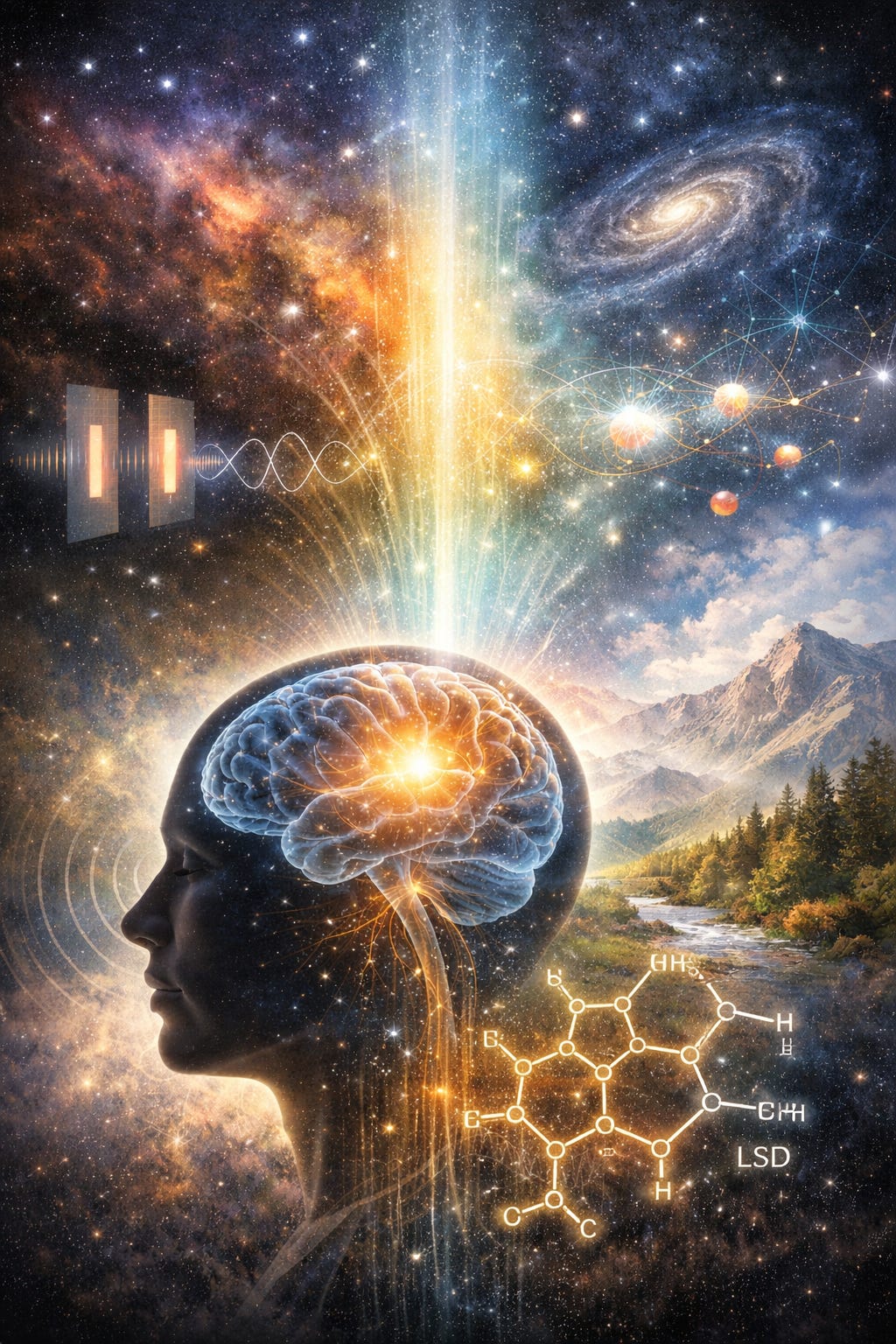
As many of you know through my other writings, my life and our work at Limina Foundation. We’ve spent a lot of time talking and thinking about consciousness. How it shows up, how it shifts, and why psychedelics seem to open something deeper. I’m not a neuroscientist or a specialist. I don’t pretend to have answers. What I do is stay curious, read widely, connect dots, and listen. Especially to my intuition. When different fields, experiences, and older wisdom traditions start pointing in the same direction. I perk up. The Telepathy Tapes definitely pushed me along this road into deeper ideas. I remember Roland Griffith delighting in saying,
“How is it that I am aware that I am aware?“
This piece is simply me following that thread. Not to convince anyone, and not to make claims I can’t prove, but to explore where these ideas might actually meet and what they might be asking of us.
There’s something in modern science known as the replication crisis. The growing realization that many experiments, particularly in psychology and neuroscience, don’t reliably repeat. Results appear, then disappear. That doesn’t mean nothing happened. It may mean we’re studying systems that don’t behave like machines. Especially in research on psychedelics.
Consciousness is one of those systems.
Beneath the data and debates, there’s a long-standing tension between local and non-local models of consciousness. In the local view, consciousness is produced entirely by the brain. In the non-local view, the brain may function more like a receiver or filter than a generator.
Experiments like the Ganzfeld studies sit right on that fault line. They resist clean repetition. Some researchers dismiss them. Others keep circling back, sensing that whatever is happening doesn’t lend itself easily to prediction or control.
That same tension shows up louder and stranger in physics.
The classic double-slit experiment showed that light behaves as either a particle or a wave depending on whether it’s observed. Later delayed-choice versions pushed this further, arranging things so the observer’s decision appeared to come after the light had already passed through the system.
And yet, the light wasn’t fooled.
Some physicists took this to mean future measurements influence past events. Others suggested something even more unsettling. That time itself may not flow the way we think it does. That past, present, and future may coexist. Sit with that for a minute.
At the quantum level, unpredictability isn’t a flaw. It’s the language. Probability, uncertainty, superposition. Classical rules no longer apply.
So where does consciousness belong in all this?
If consciousness were simply produced by neurons firing, we might expect it to behave predictably. But it doesn’t. It’s nonlinear, context-dependent, and elusive. Which raises a difficult possibility: consciousness may not be fully local at all.
In a non-local model, the brain functions less like a generator and more like a radio. A receiver immersed in an ocean of signals. Any radio can receive all frequencies at once, but without a tuning mechanism, it’s just noise. The brain, in this view, is a highly sophisticated filter.
Modern neuroscience gives us a candidate for that filter: GABA.
GABA is the brain’s primary inhibitory neurotransmitter. It quiets neural firing, enforces boundaries, and limits incoming information. It doesn’t create experience; it constrains it. Infants rely on high GABA activity to avoid sensory overload. Focus and attention are forms of filtering. Tibetan monks show elevated GABA levels during deep meditation.
When inhibition collapses during epileptic seizures for example, neural activity floods the system. And yet, some people report post-ictal bliss afterward, a brief expansive state as inhibition slowly returns. A kind of reset. For a moment, the filters are down.
Near-death experiences point in a similar direction. In rare cases where brain chemistry has been measured near death, inhibitory mechanisms drop away and the brain shows bursts of high-frequency gamma activity, often associated with memory integration. Subjectively, people report unity, peace, and overwhelming connection. And some a life review.
If the filters dissolve, perhaps consciousness expands.
This is where psychedelics enter the conversation. Not as outliers, but as clues.
Classic psychedelics don’t simply excite the brain. Through activation of the 5-HT2A serotonin receptor, they loosen top-down control and weaken inhibitory gating, including GABA-mediated filtering. The default mode network relaxes. Previously separated regions begin communicating. Hierarchies flatten. Information flows more freely.
From the inside, this doesn’t feel like hallucination. It feels like real access.
Which raises a provocative question: maybe people aren’t seeing things that aren’t there. Maybe they’re seeing more of what is there. The recurring reports of connection, love, unity, and meaning may not be fabrications, but experiences made possible when the usual constraints relax.
This begins to rhyme with placebo.
Placebo isn’t inert. It’s intent made biological. Expectation, meaning, safety, and relationship reorganize the nervous system in measurable ways. In many clinical trials, placebo accounts for a large portion of the total effect. Not as error, but as signal.
Neuromodulation fits here too. Techniques like EEG-guided, personalized TMS don’t impose content. They alter conditions. They loosen rigid loops and allow the system to reorganize itself.
Different tools. Same gesture.
Psychedelics loosen filters chemically.
Placebo and intent loosen them relationally.
Neuromodulation loosens them electrically.
Each, in its own way, reduces constraint.
Long before neuroscience had this language, Aldous Huxley described the same idea. He called it the reduction valve. The notion that the brain’s primary role isn’t to produce consciousness, but to reduce it, narrowing an otherwise overwhelming reality into something manageable.
Consciousness isn’t small because reality is small.
It’s small because reality is too large.
Many experiences we call “altered” may not be altered at all. They may be less reduced.
If the brain is a receiver, then the reduction valve determines how much of the signal we’re allowed to hear. Psychedelics, meditation, placebo, neuromodulation. Each turns the dial, just a little.
Not to escape reality.
But to remember how much of it we’re normally missing.
Which brings us to the real question.
If consciousness can expand when the brain’s filters soften, then the issue isn’t whether these states are real, but how we relate to them. The question becomes both ethical and mystical. What does it mean to touch a deeper sense of connection and then return to a world so incongruent? What at times seem insane.
We don’t need to live in expanded states all the time. Filters exist for a reason. But we may need access periodic, careful, intentional access to remember what kind of beings we actually are.
In a fractured world, the ability to experience genuine connection isn’t a luxury. To me it’s a responsibility. Because once you’ve glimpsed a wider field of belonging, it becomes harder to justify cruelty, exploitation, or indifference. Not through moral effort, but through recognition.
Unity isn’t an abstract ideal. It’s a lived perception. One the brain can remember, even after the filters return.
And perhaps the work ahead isn’t about escaping reality at all, but learning how to live more gently inside it, guided by what we’ve briefly been allowed to see.
⸻
Author’s Note
This essay reflects my own evolving understanding, shaped by curiosity, loss, explorations into altered states and life’s experience. It isn’t a declaration of belief or a claim of certainty. I’m not arguing for a single metaphysical model of consciousness, nor suggesting that science has resolved these questions. It hasn’t.
Some of my thinking has been shaped through conversations with my friend Rupert Sheldrake, where we’ve spoken openly about consciousness, nature, and God. Not as doctrine, but as lived mystery. Those conversations have helped me remain open to the possibility that what we encounter in moments of expanded awareness or even ordinary moments. Isn’t merely generated by the brain, but revealed when its usual filters soften. Or we mindfully expand our attention.
Whether one names that deeper reality consciousness, a field, spirit, or God matters less to me than the quality of what is encountered: connection, coherence, and meaning. If the sacred is present here, it may not appear through violations of natural law, but through it. Expressed quietly in relationship, resonance, and recognition.
I remain open to being wrong. But I was never convinced that reduction alone can account for what consciousness is, or why experiences of expanded connection so often change how people relate to life, to mystery, and to one another.
Thank you for your time, Micheal Williams
Wow. You put into words so well what I've come to. We seen to have layers of filters. Ten years of psychedelics, Buddhism, and I've been studying analytic idealism and consciousness in a Bernardo Kastrup study group. Yesterday we had Marjorie Woollacott on discussing her decades of research.
Yes, I think when we can remove or reduce our filters, we see and experience more that's around us. I remember the first time I gazed at a glowing tree pulsing with energy and realized that's probably what it really is. But we'd be overwhelmed to experience daily life like that...
Excellent Michael. So this is how we open to wonder and unity, by loosening the filters. The old zen saying “You should sit in meditation for 20 minutes a day. Unless you’re too busy; then you should sit for an hour,” seems apt. When living in busy and crazy times, let’s focus more, let’s practice, loosening the filters so we can live and act more aligned with the grander reality.